

Robot mop tests are essential for evaluating the performance and durability of cleaning products, especially when it comes to automated systems. One of the most critical factors for ensuring that robotic mops meet the required standards is the measurement of friction coefficients, which plays a pivotal role in the efficiency of the cleaning process.
Coefficient of Friction Testing for Robotic Mops
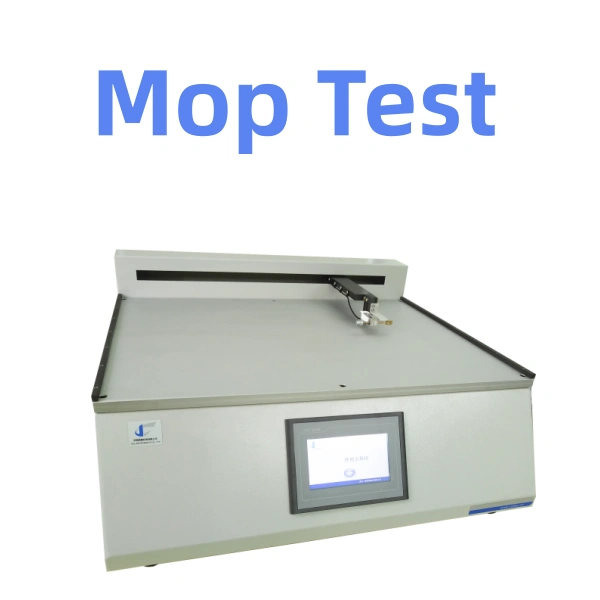
The coefficient of friction (COF) is a crucial parameter for testing robot mops. When conducting friction coefficient testing, the goal is to assess how well the mop’s surface interacts with different floor types. An optimal friction coefficient ensures effective cleaning while preventing excessive wear on the cleaning surface. Using advanced testing equipment, such as the Mop Friction Tester, manufacturers can evaluate both static and dynamic friction forces, which are essential for designing mops that provide superior cleaning power without damaging floors.
For robotic mops, achieving the right balance in COF is important for maintaining both cleaning efficiency and the longevity of the mop. Testing includes both static and kinetic friction measurements under various operational conditions to simulate real-life cleaning scenarios.
Mop Quality Assurance and Testing Equipment
The Mop Friction Tester is an indispensable tool for ensuring mop quality. It measures the friction force on different surfaces, simulating the forces a robotic mop would encounter during use. This equipment is equipped with high-precision sensors and features customizable parameters, allowing for extensive testing across a range of surfaces and conditions. The Mop Friction Tester can simulate different load conditions and movement speeds, providing reliable data for assessing the overall performance of mop materials.
The Mop Friction Tester provides critical insights into the durability of mop materials, helping manufacturers understand how their products will perform under varying conditions. By analyzing the friction forces at both the beginning and during the movement of the mop, manufacturers can identify potential weaknesses in material design and improve upon them.
Robot Mop Testing Process
The process of robot mop testing involves several steps. Initially, the sample mop is secured onto a testing frame. The system applies a consistent load to the mop, ensuring that it remains stable throughout the test. The mop is then moved across different surfaces under controlled speeds, and the friction forces are recorded.
In addition to testing the frictional properties of mop materials, tests like bubble emission packaging testing and bubble leak test methods are also performed to ensure that the mops do not retain excessive moisture or dirt. These tests ensure that mops provide the best cleaning results without leaving residues behind.
By conducting comprehensive robot mop tests using the Mop Friction Tester, manufacturers can verify that their products meet the necessary performance standards. The result is a robotic mop that not only cleans effectively but also lasts longer, reducing the need for frequent replacements.
 Azərbaycan dili
  Беларуская мова
  Български
  Čeština
  Dansk
Dansk  ไทย
ไทย  فارسی
فارسی  Ελληνικά
  Eesti
Eesti  हिन्दी
  עִבְרִית
  Suomi
Suomi  Hrvatski
  Magyar
  Հայերեն
  Íslenska
  Bahasa Indonesia
  Italiano
  ქართული
  Bahasa Melayu
  Lietuvių kalba
  Latviešu valoda
  Nederlands
  Polski
  Norsk bokmål
  Slovenčina
  繁體中文
繁體中文  O‘zbekcha
  Українська
  Српски језик
  Русский
  Svenska
  Türkçe