


Cotton Mop Quality Control Through Yarn and Thermal Shrinkage Evaluation
Cotton mop quality control plays a critical role in ensuring product consistency, durability, and user satisfaction in the cleaning and hygiene industry. Cotton string mops are widely used in commercial, medical, and industrial environments, where performance failures such as excessive shrinkage, yarn deformation, or uneven length can directly affect cleaning efficiency and service life. Effective quality control focuses not only on finished mop appearance but also on the yarn behavior under heat and tension, which strongly influences final mop performance.
For manufacturers and quality inspection agencies, cotton mop quality control requires objective, repeatable testing methods supported by standardized instrumentation. Among these methods, thermal shrinkage evaluation has become an essential tool for controlling yarn stability and maintaining consistent mop dimensions.
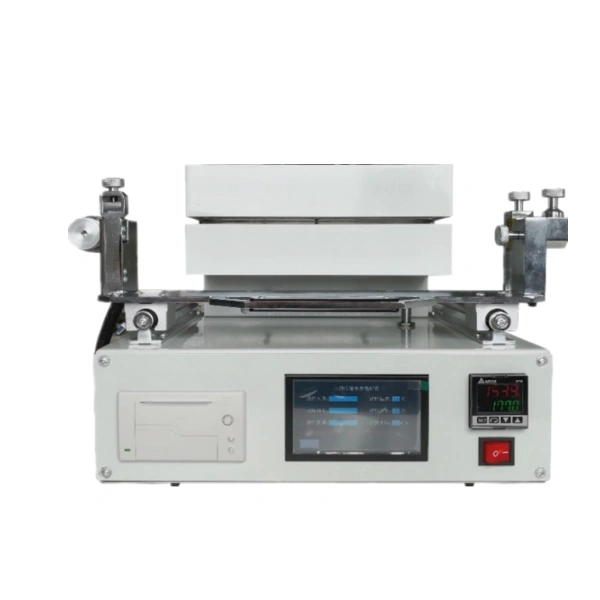
Yarn Heat Shrinkage Test as a Core Indicator of Mop Performance
Ten yarn heat shrinkage test provides direct insight into how cotton or blended yarns respond to elevated temperatures during drying, sterilization, or prolonged use. In cotton mop quality control, uncontrolled yarn shrinkage often leads to shortened mop strands, uneven mop heads, and reduced cleaning coverage.
This test evaluates the skurcz termiczny of yarns by exposing conditioned specimens to controlled hot air while maintaining a specified tension. The percentage of length change reflects the internal stress release and structural stability of the yarn. Although cotton behaves differently from synthetic fibers, blended yarns or treated cotton yarns often show measurable shrinkage patterns that must be monitored.
Standards such as ASTM D4974 and related textile shrinkage methods provide a technical foundation for evaluating yarn dimensional stability. When applied correctly, the yarn heat shrinkage test helps manufacturers establish acceptable limits for yarn selection and process control.
Importance of Thermal Shrinkage Tester in Cotton Mop Quality Control
A tester skurczu termicznego is a key instrument in modern cotton mop quality control laboratories. It allows precise temperature control, stable tension loading, and accurate shrinkage measurement, which are essential for repeatable results.
Using a thermal shrinkage tester enables manufacturers to:
- Identify yarn lots with excessive shrinkage risk
- Compare yarn suppliers objectively
- Optimize drying and finishing parameters
- Improve consistency in String Mop quality control
Accurate temperature regulation and draft shielding are especially important, as uncontrolled airflow or temperature deviation may lead to underestimated shrinkage values. Proper conditioning under standard textile laboratory environments further enhances test reliability.
Cell Instruments designs thermal shrinkage testing solutions with stable temperature control, clear digital displays, and user-friendly operation, supporting both routine quality checks and in-depth material analysis.
Mop Testing Equipment Beyond Shrinkage Measurement
While shrinkage is a key parameter, comprehensive cotton mop quality control also relies on additional sprzęt do testowania mopów to evaluate overall performance. Yarn shrinkage data should be interpreted alongside other physical indicators, such as:
- Yarn linear density consistency
- Mop strand length uniformity
- Resistance to deformation after repeated washing
- Structural stability under use conditions
By integrating thermal shrinkage testing with complementary mechanical or dimensional evaluations, manufacturers gain a complete understanding of mop durability and lifecycle behavior.
Cell Instruments supports this integrated approach by offering customizable testing solutions that adapt to special testing requirements, automated workflows, and production-line quality monitoring.
Role of ASTM D4974 in String Mop Quality Control
ASTM D4974 is commonly referenced in textile shrinkage evaluation and provides guidance for assessing dimensional changes caused by heat exposure. In cotton mop quality control, this standard helps align yarn shrinkage testing with internationally recognized procedures, improving data comparability and audit readiness.
Applying ASTM-based methods strengthens quality documentation, supports supplier qualification, and enhances credibility when dealing with institutional buyers or quality inspection agencies. It also helps reduce disputes caused by inconsistent testing practices across laboratories.
Why Cotton Mop Quality Control Matters for End Users
Effective cotton kontrola jakości mopa directly impacts end-user experience. Excessive yarn shrinkage may result in reduced mop coverage, uneven floor contact, and premature replacement. By controlling yarn thermal behavior early in production, manufacturers deliver mops that maintain their shape, length, and cleaning efficiency over time.
For healthcare, food processing, and industrial environments, consistent mop performance is not optional—it is essential for hygiene and safety compliance.
Supporting Quality Control with Cell Instruments Solutions
Cell Instruments brings extensive experience in textile testing, packaging material evaluation, and customized instrumentation. Our tester skurczu termicznego solutions are designed to support cotton mop quality control with high accuracy, operational stability, and scalability for different production needs.
By combining standard-compliant testing methods, advanced mop testing equipment, and application-specific customization, Cell Instruments helps manufacturers achieve reliable String Mop quality control while improving production efficiency and product consistency.
Cotton mop quality control, supported by yarn heat shrinkage testing and professional instrumentation, remains a foundational practice for delivering durable, high-quality cleaning products across diverse industries.
 English (UK)
  Azərbaycan dili
  Беларуская мова
  Български
  Čeština
  Dansk
Dansk  ไทย
ไทย  فارسی
فارسی  Ελληνικά
  Eesti
Eesti  हिन्दी
  עִבְרִית
  Suomi
Suomi  Hrvatski
  Magyar
  Հայերեն
  Íslenska
  Bahasa Indonesia
  Italiano
  ქართული
  Bahasa Melayu
  Lietuvių kalba
  Latviešu valoda
  Nederlands
  Norsk bokmål
  Slovenčina
  繁體中文
繁體中文  O‘zbekcha
  Українська
  Српски језик
  Русский
  Svenska
  Türkçe