


What Is Mop Cloth Coefficient of Friction Testing?
Mop Cloth Coefficient of Friction Testing is a mechanical performance evaluation method used to measure the friction behavior between mop materials and contact surfaces. It helps manufacturers understand how easily a mop moves during cleaning operations and how friction affects cleaning efficiency, user effort, and product durability.
Mop materials such as microfiber mop pads, sponge mops, and other cleaning fabrics are widely used in homes, offices, commercial facilities, and industrial environments. Because these products experience repeated sliding contact with floors, glass, furniture, and other surfaces, friction performance directly influences their usability and long-term performance.
Quality testing is important because mop materials must maintain suitable absorbency, durability, and cleaning effectiveness throughout their service life. The testing process helps identify performance changes and ensures that mop products remain reliable for applications such as cleaning kitchen surfaces, windows, and furniture.
The coefficient of friction (COF) describes the resistance generated when one surface moves against another. In mop testing, the friction value indicates whether a mop can move smoothly while still generating enough contact force to remove dust, stains, and liquid residues.
A suitable friction coefficient is essential:
- Excessive friction increases pushing force requirements and user fatigue.
- Insufficient friction may reduce cleaning effectiveness because the mop cannot maintain stable contact with the surface.
- Balanced friction performance improves cleaning efficiency, maneuverability, and user experience.
Why Is Mop Cloth Friction Testing Important?
Mop manufacturers need reliable friction data during product development, quality control, and material selection. Different mop structures, fiber compositions, backing materials, and surface conditions can significantly influence friction behavior.
Mop Cloth Friction Test Method provides quantitative results instead of relying only on manual evaluation. Engineers can use measured friction values to compare different materials and optimize product designs.
Key benefits include:
Improving Cleaning Performance
The friction coefficient affects how effectively a mop interacts with a cleaning surface. A properly designed friction level allows the mop to maintain contact while moving smoothly.
For example:
- Microfiber mop pads may require sufficient friction to capture dust particles.
- Sponge mops need controlled friction to provide effective wiping without excessive resistance.
- Industrial cleaning mops require stable movement under repeated operation.
Reducing User Effort
A mop with excessively high friction requires more force during operation, increasing physical workload. COF testing allows manufacturers to adjust materials and structures to achieve better handling performance.
Supporting Product Development
During R&D, engineers can compare:
- Different fiber materials
- Various fabric structures
- Different backing layers
- Surface treatments
- Dry and wet cleaning conditions
Testing data helps manufacturers select suitable materials and improve product competitiveness.
Ensuring Batch-to-Batch Quality
Production variations may influence surface properties. Regular friction testing helps quality control teams verify that finished products maintain consistent performance.
Principle of Coefficient of Friction Measurement
The coefficient of friction is calculated by dividing the force required to move one surface across another by the perpendicular force applied between the two surfaces.
The basic formula is:
COF = Friction Force / Normal Force
Mop Cloth Coefficient of Friction Testing generally evaluates two friction characteristics:
| Friction Type | Definition | Testing Meaning |
|---|---|---|
| Static Coefficient of Friction (µs) | Force required to start movement | Indicates initial resistance before sliding begins |
| Kinetic Coefficient of Friction (µd) | Force required to maintain movement | Indicates resistance during continuous sliding |
The static coefficient reflects how difficult it is to start moving a mop, while the kinetic coefficient represents the effort required during normal cleaning movement.
Mop Cloth Friction Test Method and Procedure
The Mop Cloth Friction Test Method uses a coefficient of friction tester to simulate the sliding interaction between mop material and a reference surface.
A typical testing procedure includes the following steps:
1. Sample Preparation
The mop cloth sample is fixed onto an aluminum or plastic frame to ensure stable positioning during testing.
2. Applying Normal Load
The assembled sample is placed under a specified weight. The applied load creates a controlled contact pressure between the mop material and the testing surface.
3. Sliding Test
The sample assembly is pulled at a controlled speed over a defined distance. During movement, the instrument continuously measures friction force.
According to the COF-S1 testing method, the sample frame and weight assembly are pulled at 500 mm/min over a 500 mm stroke, and both static and kinetic friction coefficients are recorded.
4. Data Analysis
The testing system calculates friction values and provides quantitative results for:
- Static COF
- Kinetic COF
- Friction force changes during movement
These results help engineers evaluate whether the mop material meets design requirements.
Testing Equipment for Mop Cloth Coefficient of Friction Testing
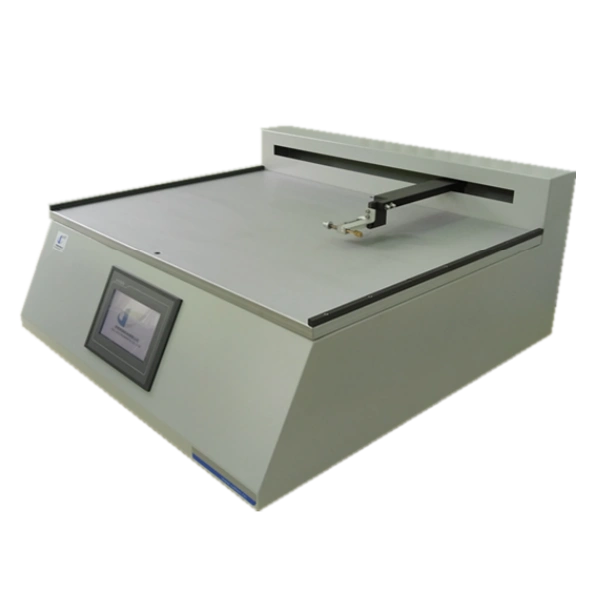
A dedicated coefficient of friction tester provides controlled testing conditions and repeatable results. The COF-S1 Mop Cloth Coefficient of Friction Tester is designed specifically for mop and cleaning materials, including microfiber mop pads and sponge mops with foam blocks made from cellulosic, rubber, or plastic materials.
The instrument uses PLC control and an HMI touchscreen interface, providing stable operation for quality control and product development applications. It supports adjustable testing conditions according to user requirements.
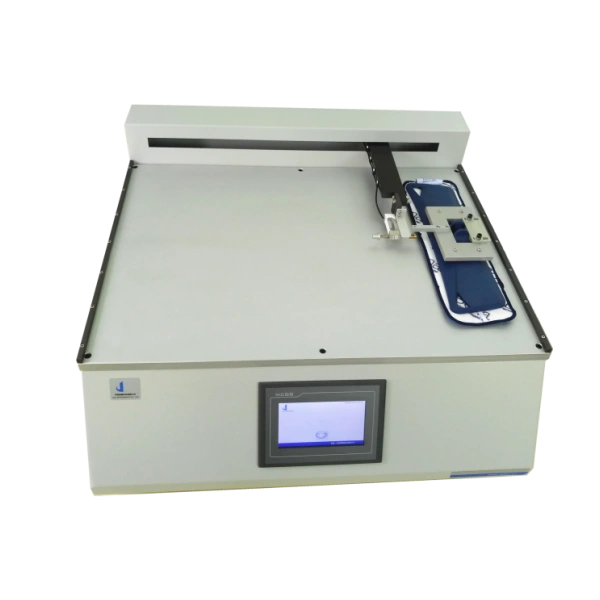
Main Technical Parameters
| Parametrs | Specifikācija |
|---|---|
| Spēka diapazons | 100 N |
| Izšķirtspēja | 0.5% FS |
| Testa ātrums | Adjustable 1–1000 mm/min |
| Ātruma precizitāte | 0,1 mm/min |
| Ragavu izmērs | 100 × 100 mm |
| Ragavu svars | 225 g ±1 g |
| Total Sample Weight | 520 g ±1 g |
| Insults | 500 mm |
| Load Cell Height | 50 mm |
| Pārbaudes režīms | 5 grupas |
| Barošanas avots | 110–220 V |
The above parameters are based on the COF-S1 product specifications provided by Cell Instruments.
Applicable Materials and Industries
Mop Cloth Coefficient of Friction Testing applies to various cleaning materials and industries.
Tested Materials
| Material Type | Examples | Testing Purpose |
|---|---|---|
| Microfiber Mop Cloth | Microfiber pads, reusable mop heads | Evaluate sliding behavior and cleaning usability |
| Sponge Mop Materials | Foam block mop heads | Analyze movement resistance |
| Cellulosic Materials | Natural fiber cleaning materials | Compare friction performance |
| Rubber or Plastic Components | Mop backing structures | Evaluate contact friction characteristics |
The COF-S1 tester is specifically applicable to mop and cleaning materials where friction behavior changes according to liquid, dust, or dry surface conditions.
Industry Applications
| Industry | Pieteikums |
|---|---|
| Household Cleaning Products | Quality control of consumer mops |
| Commercial Cleaning Equipment | Performance verification for professional cleaning tools |
| Industrial Cleaning | Evaluation of heavy-duty cleaning materials |
| Mop Manufacturing | Material selection and production inspection |
| R&D Laboratories | Development of new cleaning materials |
Related Standards for Mop Cloth Friction Testing
Mop Cloth Coefficient of Friction Testing can reference internationally recognized friction measurement methods. The specific standard selection depends on the material type, application requirements, and testing objectives.
| Standard | Application Reference |
|---|---|
| ASTM D1894 | Standard test method for static and kinetic coefficients of friction of plastic film and sheeting; commonly referenced for friction measurement principles |
| ISO 8295 | Plastics — Film and sheeting — Determination of coefficients of friction |
The COF-S1 product documentation identifies ASTM D1894 and ISO 8295 as reference standards for coefficient of friction testing.
How COF Testing Supports Mop Quality Control
For manufacturers, friction testing provides measurable information throughout the product lifecycle.
During material development, engineers can compare different fabrics and structures.
During production inspection, quality teams can monitor consistency between batches.
During customer validation, test results can support product performance claims.
Combining friction testing with other evaluations, such as absorbency testing, durability testing, and wear resistance testing, provides a more complete understanding of mop performance.
A professional Mop Cloth Coefficient of Friction Testing system helps manufacturers make data-driven decisions instead of relying only on subjective user feedback.
Conclusion
Mop Cloth Coefficient of Friction Testing is an important quality evaluation method for understanding the interaction between mop materials and cleaning surfaces. By measuring static and kinetic friction coefficients, manufacturers can optimize product design, improve cleaning efficiency, reduce user effort, and maintain consistent product quality.
With controlled testing conditions, adjustable parameters, and compatibility with reference standards such as ASTM D1894 and ISO 8295, a dedicated coefficient of friction tester provides valuable support for mop manufacturers, laboratories, and R&D teams developing advanced cleaning products.
Šūnu instrumenti provides professional coefficient of friction testing solutions designed for mop manufacturers, laboratories, and quality control teams. Our testing systems offer accurate friction measurement, flexible test configurations, and customized solutions for different material requirements. Contact Cell Instruments to learn more about Mop Cloth Coefficient of Friction Testing equipment and discover how precise mechanical testing can improve your product development and quality assurance processes.
 English (UK)
  Azərbaycan dili
  Беларуская мова
  Български
  Čeština
  Dansk
Dansk  ไทย
ไทย  فارسی
فارسی  Ελληνικά
  Eesti
Eesti  हिन्दी
  עִבְרִית
  Suomi
Suomi  Hrvatski
  Magyar
  Հայերեն
  Íslenska
  Bahasa Indonesia
  Italiano
  ქართული
  Bahasa Melayu
  Lietuvių kalba
  Nederlands
  Polski
  Norsk bokmål
  Slovenčina
  繁體中文
繁體中文  O‘zbekcha
  Українська
  Српски језик
  Русский
  Svenska
  Türkçe